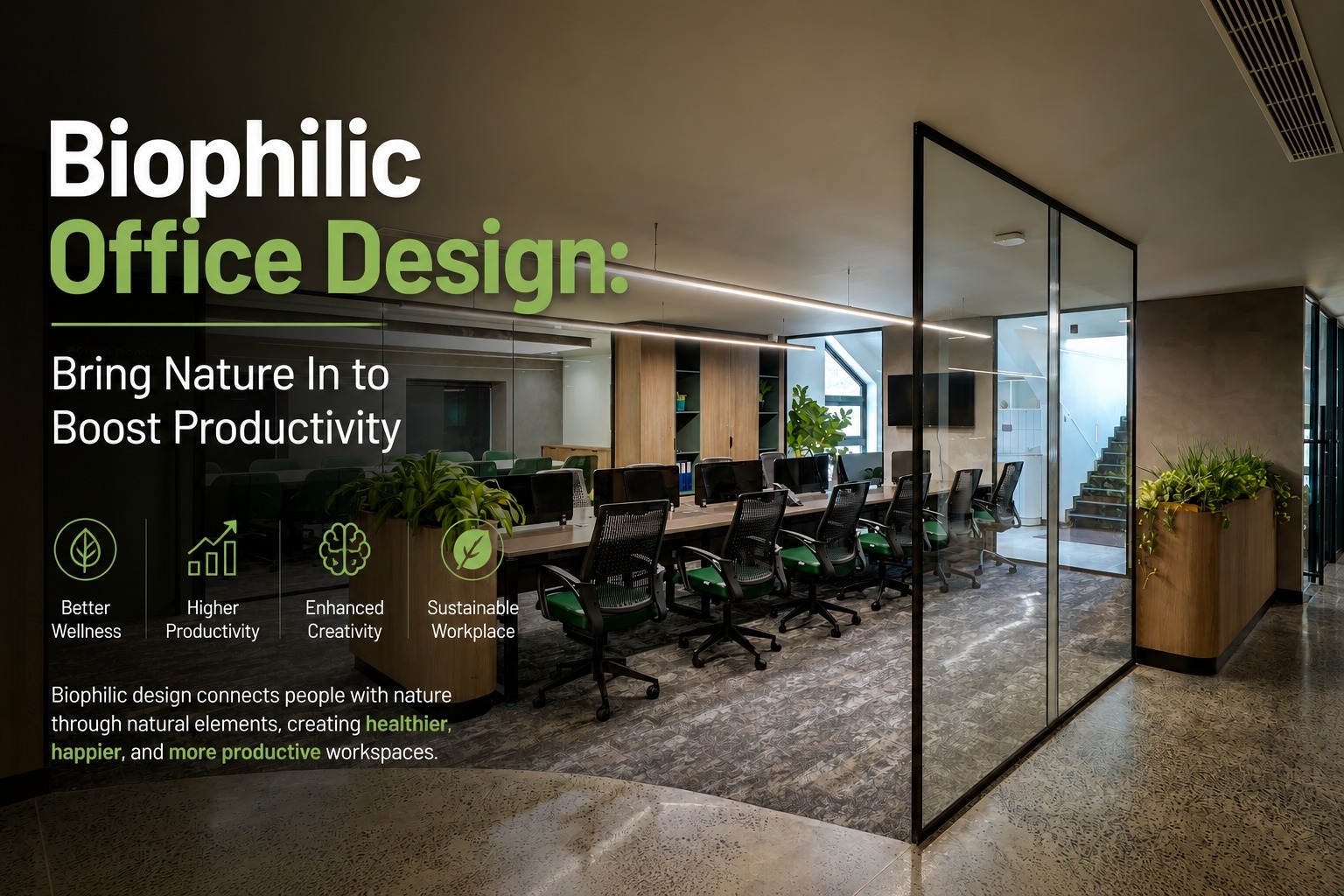
Biophilic Office Design: Bring Nature In to Boost Productivity
Biophilic office design is the practice of integrating natural elements – daylight, greenery, water, natural materials, organic forms and views of nature – into workplace interiors and architecture. Research links biophilic design in the workplace to a 15% rise in reported wellbeing, 6% higher productivity, and 15% greater creativity.
That single paragraph is why the world’s most forward-thinking companies are rethinking their corporate office interiors. Humans spend close to 90% of their lives indoors, yet our brains evolved outdoors. Biophilia, literally “love of life,” is the innate human tendency to seek connection with nature. When a workspace ignores that instinct, people feel it: fatigue, distraction, absenteeism. When a workspace honours it, the results show up in focus, mood, retention and even the balance sheet.
In this guide, our commercial interior designers break down what biophilic office design really involves, the science behind it, the core design elements, how it plays out in Indian and GCC workplaces, and how to bring it into a premium office environment without turning your workplace into a jungle.
Planning a workspace transformation? Speak to Creatabar’s commercial interior design team
What Is Biophilic Office Design?
Biophilic office design applies the principles of biophilic design – a human-centric design philosophy rooted in our biological connection to nature – specifically to workplaces. It goes far beyond placing a few potted plants near reception. True biophilic design for office environments works at three levels:
- Direct connection with nature – living walls, indoor plants, water features, natural light, fresh air, outdoor views.
- Indirect connection with nature – natural materials (wood, stone, rattan, linen), nature-inspired colour palettes, organic forms and patterns, botanical artwork, nature imagery.
- Spatial experience of nature – layouts that mimic how humans thrive in natural settings: open “prospect” views, sheltered “refuge” zones, mystery, and gentle transitions between spaces.
This framework draws on the widely referenced 14 Patterns of Biophilic Design published by Terrapin Bright Green, which connects each pattern to measurable outcomes in stress reduction, cognitive performance and emotional wellbeing.
Biophilic Design vs. Simply “Adding Plants”
| Aspect | Adding Plants | Biophilic Office Design |
| Approach | Decorative afterthought | Integrated design strategy from the concept stage |
| Scope | Greenery only | Light, air, materials, acoustics, layout, views |
| Involvement | Facilities team | Commercial interior designers + biophilic architecture |
| Outcome | Aesthetic lift | Measurable gains in wellbeing, focus and retention |
| Longevity | Fades without care | Embedded in the architecture of the space |
In short: biophilia in office design is a system, not a styling trick. That is why it belongs in the hands of experienced commercial interior designers who can weave it through space planning, MEP, lighting and material selection from day one.
The Science: Why Biophilic Design in the Workplace Boosts Productivity
Biophilic design is one of the few workplace strategies backed by decades of peer-reviewed evidence:
- Wellbeing and creativity: The global Human Spaces study (Professor Sir Cary Cooper, 7,600 office workers across 16 countries) found employees in workspaces with natural elements reported 15% higher wellbeing, 6% higher productivity, and 15% higher creativity than those in spaces without.
- Focus and output: Research from the University of Exeter found that enriching a lean office with plants improved productivity by around 15%, with gains in concentration and perceived air quality.
- Stress recovery: Roger Ulrich’s landmark research showed that even a view of greenery measurably speeds recovery and lowers stress markers, a principle now foundational to evidence-based design.
- Daylight and sleep: Studies on natural light in the workplace link window proximity to better sleep quality and higher daytime alertness, directly affecting performance the next morning.
- The absence gap: In the same Human Spaces research, nearly half of employees surveyed had no natural light and no greenery in their work environment – a silent tax on performance most leadership teams never see in a report.
For decision-makers, the message is simple: in a knowledge economy where salaries dwarf real estate costs, even a low single-digit productivity gain from biophilic office interiors delivers returns that few other design investments can match.
Curious what this evidence looks like applied to your floor plate? Request a design consultation with Creatabar
7 Core Elements of Biophilic Office Interiors
1. Natural Light & Circadian Lighting
Daylight is the single most powerful biophilic element. Thoughtful biophilic architecture positions workstations within reach of windows, uses glass partitions to let light travel deep into the floor plate, and layers in circadian lighting, artificial light that shifts colour temperature through the day to mirror the sun. The result: sharper morning focus, softer evening wind-down, and a workspace that works with human biology rather than against it.
Designer’s note: In GCC markets, where intense sun meets deep floor plates, the craft lies in managed daylight-high-performance glazing, mashrabiya-inspired screens, and light shelves that admit light without glare or heat gain.
2. Living Walls, Moss Walls & Indoor Planting
A living green wall is the signature statement of biophilic design in office environments, an instant brand moment at reception and a functioning air-quality asset. Where irrigation or maintenance is a constraint, preserved moss walls deliver the same visual softness with minimal upkeep. Beyond feature walls, layered planting, floor planters, desk greenery, and cascading species on open shelving, distribute the benefit across every zone rather than concentrating it at the entrance.
Best low-maintenance indoor plants for offices in Indian and GCC climates: areca palm, snake plant (sansevieria), ZZ plant, money plant (pothos), peace lily, rubber plant and dracaena, all proven performers in air-conditioned interiors.
3. Natural Materials & Textures
Wood grain, natural stone, terracotta, cane, jute, linen, and wool speak to the senses in a way laminates never will. In premium office fitouts, this translates into timber slatted ceilings, stone-clad feature walls, veneer joinery and tactile upholstery. This is indirect biophilia — the space feels natural even where no plant is present – and it is where luxury workspace design and biophilic interior design converge most beautifully.
4. Water Features & Natural Soundscapes
The sound of moving water lowers heart rate and masks distracting speech – a double win for acoustic comfort in open-plan offices. A sculptural water wall in the lobby or a quiet courtyard fountain adds sensory depth that photographs cannot capture but that every visitor remembers. Where a physical feature is impractical, curated natural soundscapes achieve a similar calming effect.
5. Organic Forms, Patterns & Biomorphic Design
Nature rarely draws a straight line. Curved partitions, leaf-inspired acoustic baffles, fractal-patterned screens, and flowing furniture layouts create what researchers call biomorphic connection – spaces that feel intuitively comfortable because their geometry echoes the natural world. Paired with earthy, nature-inspired colour palettes (forest greens, sand, terracotta, sky tones), the entire workspace reads as calm, considered and quietly premium.
6. Views, Prospect & Refuge
Great biophilic design architecture choreographs how people experience space: open sightlines across the office (prospect) energise and orient, while enclosed nooks, booths and garden-facing focus rooms (refuge) offer restoration. Workstations oriented toward windows and greenery – rather than blank walls – turn every glance up from the screen into a micro-recovery moment.
7. Air Quality & Natural Ventilation
Biophilia, you can breathe. Fresh-air strategies, high-efficiency filtration, humidity control, and VOC-free, sustainable materials keep indoor air quality high, one of the strongest predictors of cognitive performance in workplace studies. Combined with planting, it is the invisible layer of green office design that people feel as “this office just makes me feel good.”
Biophilic Office Design in India & the GCC: A Regional Perspective
Biophilic design is not a Scandinavian import to be copy-pasted. The most compelling nature-inspired workspaces in India and the GCC are rooted in regional design intelligence:
- India: Courtyard-centred planning, verandah-style breakout zones, jaali screens filtering light, and hardy tropical planting draw on centuries of climate-responsive Indian architecture. In cities like Kochi, Bengaluru, Mumbai, and Delhi NCR, biophilic office interiors also serve as a decisive edge in the war for talent – younger professionals now weigh workplace experience alongside compensation.
- GCC: In Dubai, Abu Dhabi, Riyadh, Doha, and Kuwait City, where summer temperatures keep life indoors, the office often becomes the occupant’s primary experience of nature. Shaded atriums, indoor gardens, water elements and desert-adapted planting palettes create an oasis effect, deeply aligned with the region’s cultural heritage of gardens as sanctuaries.
- Sustainability & compliance: Biophilic strategies map directly onto the WELL Building Standard, LEED and regional green-building frameworks such as Estidama and the Saudi Green Building Forum, supporting corporate ESG goals while elevating the human experience of the workplace.
Operating across India, the GCC – or beyond? Creatabar designs and delivers premium commercial interiors worldwide, with a presence in 12+ nations – one design language, executed to international standards wherever your business takes you. Explore our office & workspace portfolio
The Business Case: What Biophilic Design in the Workplace Delivers
| Business Priority | How Biophilic Office Design Contributes |
| Productivity & focus | Daylight, greenery, and air quality are linked to measurable gains in output and concentration |
| Talent attraction & retention | Nature-rich, wellness-focused offices consistently rank among the most desired workplaces |
| Reduced absenteeism | Better air, light, and stress recovery correlate with fewer sick days |
| Brand & client perception | A living wall and daylight-filled lobby communicate a premium, future-facing brand before a word is spoken |
| ESG & certification goals | Direct alignment with WELL, LEED, and regional green-building standards |
| Real-estate value | Wellness-certified, biophilic buildings command stronger occupier demand |
For leadership teams, biophilic design in the workplace is best understood not as décor spend but as infrastructure for human performance – with the added advantage that it happens to be beautiful.
How to Implement Biophilic Office Design: A 6-Step Roadmap
- Audit the existing environment – Map daylight penetration, air quality, views, acoustics, and material palette. Identify the “nature deserts” on your floor plate.
- Define outcomes, not objects – Decide what the design must achieve – deeper focus, faster collaboration, stronger client impression – before selecting a single plant or finish.
- Engage commercial interior designers early. Biophilic architecture decisions (glazing, atriums, ceiling heights, MEP for irrigation and ventilation) are far more powerful and far more economical when made at the concept stage rather than retrofitted.
- Layer the elements. Combine direct nature (planting, light, water), indirect nature (materials, patterns, palettes), and spatial strategies (prospect, refuge, wayfinding through greenery) so the effect is immersive, not decorative.
- Design for maintenance from day one. Specify resilient species, integrated irrigation, accessible planters, and preserved-moss alternatives where upkeep must stay minimal. A wilting green wall damages a brand faster than no green wall at all.
- Measure and refine. Track occupancy, satisfaction surveys, absenteeism, and space utilisation post-handover. Biophilic office interiors are living systems – the best ones evolve.
Want this roadmap tailored to your workspace? Book a consultation with Creatabar’s design studio
Common Mistakes to Avoid
- Plant-washing: A dozen pots by the lift lobby are not biophilia in office design – it is decoration. Depth comes from light, air, material, and layout working together.
- Ignoring maintenance reality: Living systems need planned care. Under-specified irrigation is the most common reason biophilic features fail within a year.
- Fake everything: Artificial plants have a place in low-light zones, but an office of visibly plastic greenery signals the opposite of authenticity, the very quality biophilic design exists to express.
- Sacrificing acoustics: Hard natural materials (stone, timber, glass) are beautiful but reflective. Pair them with planting, soft textures and engineered acoustic solutions — see our guide to acoustic PET panels for offices.
- Treating it as a trend: Biophilia is a permanent human need, not a seasonal aesthetic. Design it into the bones of the workplace, and it will outlast every style cycle.
Frequently Asked Questions About Biophilic Office Design
Biophilic office design is the intentional integration of nature – daylight, plants, water, natural materials, organic forms and outdoor views – into workplace interiors and architecture. It is grounded in biophilia, the innate human affinity for nature, and is proven to improve wellbeing, focus, and productivity at work.
Natural elements reduce stress hormones, restore attention, and improve air quality. Global research links biophilic design in the workplace to roughly 15% higher wellbeing, 6% higher productivity and 15% greater creativity, while studies on office planting report productivity gains of up to 15% compared with lean, nature-free spaces.
The core elements are: natural and circadian lighting, living walls and indoor planting, natural materials and textures, water features, organic forms and nature-inspired patterns, outdoor views with prospect-and-refuge layouts, and superior indoor air quality through ventilation and non-toxic materials.
Yes, arguably more valuable there. Because people spend more time indoors in hot climates, the workplace often becomes their primary contact with nature. Strategies such as shaded atriums, filtered daylight, indoor gardens, water elements, and climate-adapted planting bring the benefits of biophilia without compromising thermal comfort.
Sustainable design reduces a building’s impact on nature (energy, water, materials); biophilic design increases nature’s positive impact on people (well-being, cognition, mood). The two are complementary; premium workplaces today pursue both, often through frameworks like the WELL Building Standard and LEED.
Not when designed intelligently. Experienced commercial interior designers specify resilient plant species, integrated irrigation, accessible planters, and low-care alternatives such as preserved moss walls, so the space stays vibrant with a realistic maintenance plan, not a full-time gardener.
Areca palm, snake plant, ZZ plant, money plant (pothos), peace lily, rubber plant, and dracaena are reliable performers in air-conditioned Indian and GCC offices – tolerant of indoor light levels and forgiving of irregular care.
A firm that combines biophilic interior design expertise with architectural and technical delivery capability – because success depends on glazing, HVAC, irrigation, lighting, and acoustics working together. Creatabar Interior Architecture provides this integrated design-to-delivery approach across India and the GCC.
Conclusion
Biophilic office design has moved from “nice to have” to a defining marker of a serious, people-first organisation. The evidence is settled: workplaces that bring nature in see stronger focus, healthier teams, richer creativity and a brand presence that no marketing budget can replicate. The only real question left is execution – because the gap between a truly biophilic workplace and a lobby with plants is the gap between design intelligence and decoration.
That is where Creatabar Interior Architecture comes in. As award-winning commercial interior designers delivering premium workspaces across India and the GCC – with 1200+ projects and over 10 lakh sq ft designed, we integrate biophilic design into the architecture of your office from the first concept sketch to turnkey handover: daylight strategy, living installations, natural material palettes, acoustic balance and layouts engineered around how your people actually work.
If your organisation is ready for a workspace that elevates performance as elegantly as it elevates your brand, we would be delighted to show you what nature-led design can do.
Bring Nature Into Your Workplace
Partner with Creatabar Interior Architecture – premium biophilic office design across India & the GCC.
+91 7994 405 554 · Request Your Design Consultation → View Our Office & Workspace Portfolio → · Explore Turnkey Interior Fitout →