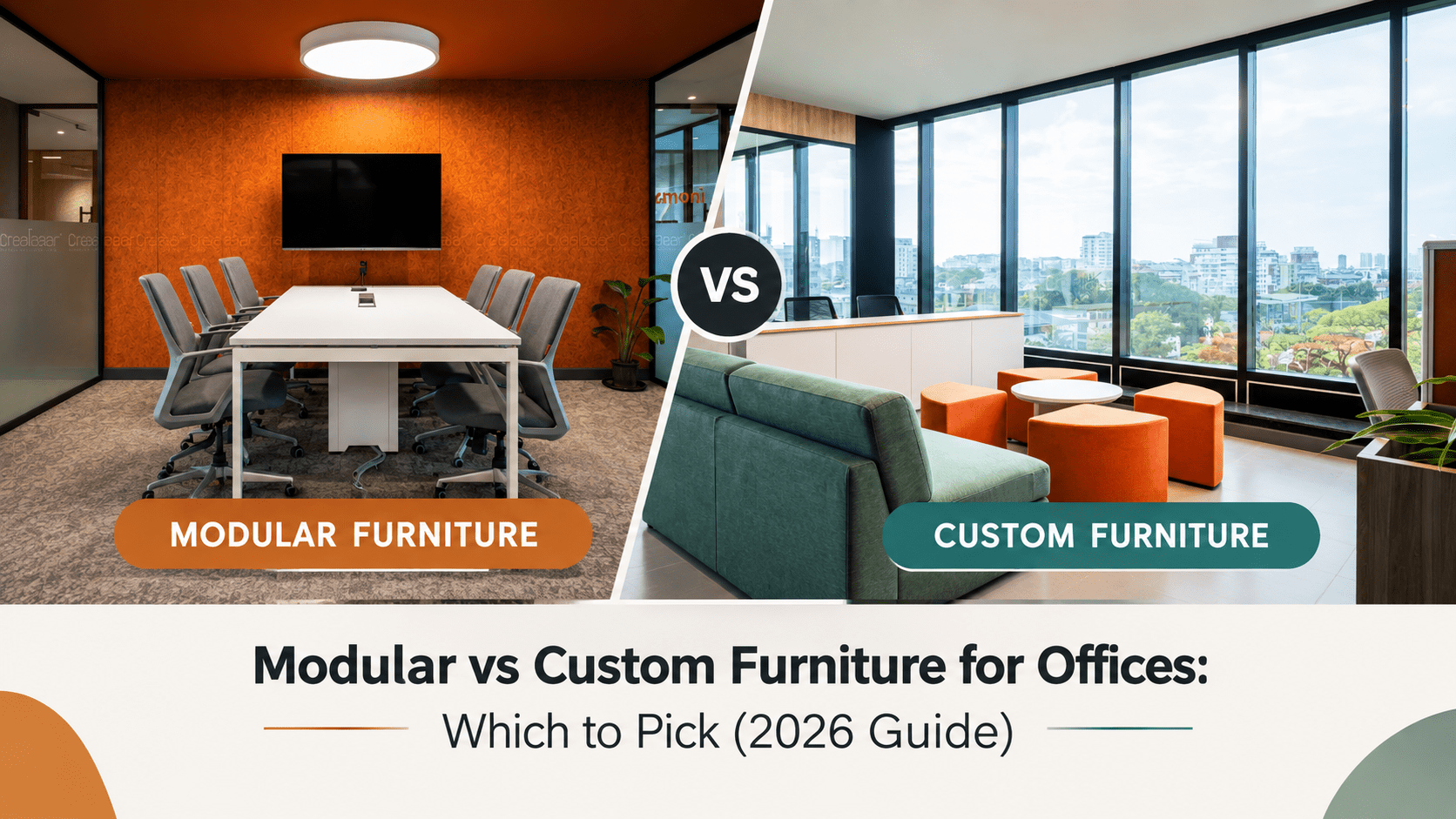
Modular vs Custom Furniture for Offices: Which to Pick (2026 Guide)
In office design, choose modular furniture when you need flexible, reconfigurable workstations that adapt to hybrid attendance, team growth, and activity-based working, and choose custom furniture when a signature workspace, a bespoke brand story, and a luxury executive experience are the goal. The best-performing offices rarely pick one outright: they build on a modular backbone (desks, storage, collaborative seating) and add custom hero pieces (reception, boardroom table, executive suites, statement joinery) so the space works operationally and looks unmistakably like your brand.
Office furniture is no longer a line item – it’s a strategic asset. It decides how efficiently you use every square foot, how well hybrid teams collaborate, how comfortable and productive your people are, and what a visiting client feels the moment they walk into reception. Get it right, and your workspace quietly improves space efficiency, talent retention, and brand impression. Get it wrong, and you’re locked into expensive, disruptive renovations the next time your team changes shape.
So when you sit down with your office interior designers to plan a new HQ or a refit, one decision shapes your budget, timeline, brand identity and adaptability for the next decade: modular or custom?
This guide breaks down the trade-offs the way experienced commercial interior designers actually weigh them – with a clear decision framework, a side-by-side comparison, 2026 workplace trends, and where each approach wins.
Planning a new office or workspace refit? Talk to a commercial interior design studio that has delivered 1,800+ projects across India and the GCC. Book a free design consultation with Creatabar →
What “modular” and “custom” mean in office furniture
Before comparing, define both clearly – because in commercial interiors, the words carry specific meaning.
Modular furniture is built from standardised, interchangeable components – reconfigurable workstations, movable desks, mobile storage, sectional collaborative seating, moveable partitions – that can be rearranged, expanded or downsized without redesigning the room. Modular office furniture lets a floor plate shift from focused work to a team huddle to a presentation, sometimes within the same day, with minimal downtime and no facilities crew.
Custom furniture is designed and fabricated specifically for your space – a bespoke reception desk, a signature boardroom table sized to your exact room, executive suites in your brand’s material palette, custom millwork that turns an awkward column into a feature. Custom pieces are where a workspace earns its visual signature and, in luxury and C-suite environments, its premium feel.
Most real projects are a hybrid: a modular backbone for the working floor, plus custom hero pieces that carry the brand. Knowing which pieces to modularise and which to bespoke is exactly what separates a considered office interior from a catalogue fit-out.
Modular vs Custom Office Furniture: side-by-side comparison
| Factor | Modular Furniture | Custom Furniture |
| Layout flexibility | Excellent – reconfigure for team changes, hybrid days and activity zones in minutes | Limited – pieces are fixed to a planned arrangement |
| Brand signature | Good, but shared with other offices using the same system | Exceptional – a look no competitor can replicate |
| Best-fit zones | Open-plan floors, coworking, agile teams, breakout & collaboration areas | Reception, boardroom, executive suites, flagship HQ |
| Space optimisation | Strong for fluctuating occupancy and growth | Strong for maximising a specific, considered layout |
| Maintenance & repair | Easy – swap or add a single component, minimal disruption | Modular-custom detailing (standard hardware, replaceable parts) keeps repairs manageable |
| Lead time | Shorter – systems are production-ready | Longer – design, prototyping and fabrication |
| Long-term value | Lower entry, easy phased scaling | Higher craft, stronger brand recall and executive experience |
| Scalability across sites | Ideal for multi-site roll-outs and expansion | Ideal for singular, destination headquarters |
Rule of thumb: the more a zone needs to impress (reception, boardroom, C-suite), the more you lean custom. The more it needs to flex (working floors, collaboration, hybrid teams), the more you lean modular.
When modular furniture is the right call
Choose a modular-led approach when your office design has to adapt faster than it has to impress. It shines when:
- You run hybrid or activity-based working. Height-adjustable desks, mobile storage and reconfigurable workstations let people choose how and where they work day to day. Organisations implementing flexible, modular layouts report 30–40% improvements in space efficiency.
- Your team is growing or restructuring. Modular systems expand, downsize or rearrange to match changing team sizes – without the cost and downtime of fixed-layout renovations.
- Occupancy fluctuates. Traditional assigned seating leaves desks empty across the week. Modular, shared and zoned settings let you plan around utilisation, not headcount.
- You’re rolling out multiple offices. Standardised systems keep design language, ergonomics and lead times consistent across locations.
The trade-off: because modular systems are available to everyone, an office can look generic unless skilled office interior designers layer in material, lighting, biophilic elements and spatial identity around the furniture.
Building an agile, hybrid-ready workspace and searching “office interior designers near me”? Creatabar designs flexible floors that still feel premium. See our office & workspace design work →
When custom furniture is worth the investment
Custom furniture is where an office stops looking fitted out and starts looking authored. Choose a custom-led approach when:
- Brand differentiation is the strategy – Reception, the boardroom and executive suites are where clients and top talent form their first impression. Bespoke desks, signature tables and custom joinery become the moments people remember and photograph.
- Your space is unusual – Custom joinery turns columns, awkward corners and dead zones into functional, on-brand features that off-the-shelf pieces can’t fit.
- You’re designing for the C-suite or luxury office furniture standards – Premium materials, considered ergonomics and bespoke detailing signal status and care in a way catalogue ranges can’t.
- Materials tell your story – Natural wood, stone, premium veneers and handcrafted detail are easiest to control fully through custom fabrication, and they age into an asset rather than a liability.
Smart studios keep custom maintainable: standardised hardware and replaceable components mean even bespoke pieces can be serviced quickly. Custom doesn’t have to mean fragile – engineered to contract grade, it means enduring. Well-made commercial furniture typically lasts around 7-10 years with proper care, and often far longer for bespoke joinery.
Designing a headquarters, boardroom or executive floor that has to impress? Our studio designs and fabricates bespoke, brand-defining interiors. Start your custom office design brief →
The hybrid approach most great offices actually use
Here’s what experienced commercial interior designers rarely say out loud: the real answer is usually “both.”
A proven pattern for modern office design is to modularise the working floor and customise the brand moments:
- Modular backbone – reconfigurable workstations, sit-stand desks, mobile storage and collaborative seating that flex with hybrid attendance and team growth.
- Custom brand moments – a bespoke reception desk, a signature boardroom table, executive suites and statement millwork that carry your identity.
- Zoned by activity – focus rooms, collaboration areas, lounges and quiet booths, each furnished to purpose rather than one-size-fits-all.
- Contract-grade everything – whether modular or custom, insist on commercial durability (look for BIFMA-tested construction) and ergonomic, sustainable materials so the space performs for years.
This blend delivers operational flexibility and brand distinction, the combination that lifts productivity, retention, and client impression together, rather than trading one for another.
How to decide: a 5-question framework
Run your project through these five questions with your office interior designers before committing:
- What does the zone need to do – flex or impress? Working floors and collaboration → modular. Reception, boardroom, executive → custom.
- How volatile is your headcount and hybrid pattern? More change favours modular systems you can reconfigure.
- Single HQ or multi-site? Destinations reward custom; roll-outs reward modular standardisation.
- Where does your budget create the most impact? Spend custom on the moments clients and talent see first and remember longest.
- What’s your growth and maintenance reality? Choose whichever approach lets you scale and service the space with minimal disruption.
If you can’t answer these confidently, that’s the signal to bring in a commercial interior design partner before you buy a single desk; furniture bought ahead of a floor plan is the most common (and most expensive) office fit-out mistake.
2026 office design trends shaping the furniture decision
The modular-vs-custom choice doesn’t happen in a vacuum. The dominant office design trends of 2026 are pushing furniture in a clear direction:
- Flexibility is now a design principle, not a compromise. Modular furniture systems and moveable walls let companies reconfigure layouts rapidly, so spaces transform from focus mode to collaboration to presentation without costly reconstruction.
- Hybrid work rewrote the brief. Offices are planned around fluctuating occupancy and utilisation, with shared, zoned and mobile settings replacing fixed assigned desks.
- Ergonomics and wellbeing are expected, not optional. Sit-stand desks, lumbar-support seating, acoustic privacy and biophilic design are now baseline for productivity and retention.
- Sustainability and longevity. Durable, modular, circular-economy furniture – with take-back and reconfiguration built in – is a long-term priority, not a nice-to-have.
The takeaway: a modular backbone keeps you agile for how people work now, while custom detailing delivers the identity, warmth and executive presence that catalogue systems can’t.
Want a workspace built on 2026’s best thinking? Explore Creatabar’s project portfolio → and see flexibility and craft working together. (See also our guide to biophilic office design →.)
Office furniture across India, the GCC and global markets
Furniture strategy also shifts with geography and format. Across India: from Kochi and Bangalore to Chennai, Mumbai and Delhi NCR – and the GCC: Dubai, Abu Dhabi, Riyadh, Jeddah, Doha, Kuwait City and Muscat – premium organisations increasingly favour a hybrid model: modular flexibility for fast-scaling teams, plus custom, brand-led hero pieces that root a headquarters in its identity and market.
For corporate HQs and luxury workplaces in particular, that authored identity is exactly what signals prestige to clients and talent – and builds the kind of brand recall that outlasts a single relocation. A commercial interior design partner working across multiple markets can translate one brand concept into furniture and fit-out that reads as luxurious and native in every location.
Frequently asked questions
Is modular or custom furniture better for an office?
Neither is universally better. Modular furniture wins on flexibility, faster reconfiguration and easy scaling – ideal for hybrid teams, open-plan floors and multi-site roll-outs. Custom furniture wins on brand signature, prestige and executive experience – ideal for reception, boardrooms and C-suite spaces. Most successful offices blend both: a modular working floor with custom brand moments.
What is modular office furniture?
Modular office furniture is built from standardised, interchangeable components – reconfigurable workstations, movable desks, mobile storage and moveable partitions – that can be rearranged, expanded or downsized without redesigning the space. It’s the preferred choice for hybrid and activity-based offices because it adapts to changing team sizes with minimal downtime.
Does modular furniture look cheap or generic?
Not when it’s well specified. Modular systems can look generic if chosen in isolation, but skilled office interior designers layer material, lighting, biophilic elements and spatial identity around them, and pair them with custom hero pieces – so the workspace feels premium and distinctly branded.
Which lasts longer – modular or custom office furniture?
Both can last a long time when built to commercial (contract) grade. Well-made commercial furniture typically lasts around 7–10 years with proper maintenance, and bespoke joinery often longer. Durability depends on construction and materials – look for BIFMA-tested, contract-grade pieces – more than on whether the item is modular or custom.
How does office furniture affect productivity?
Furniture shapes comfort, focus, collaboration and space efficiency. Ergonomic seating and sit-stand desks support health and concentration, while flexible, zoned layouts let people match their space to the task. Organisations using flexible, modular layouts report significant gains in space efficiency and workplace satisfaction.
How do I find good office interior designers near me?
Look for a commercial interior design firm with a proven office and workspace portfolio, turnkey fit-out capability, and experience in your market. Creatabar works with corporate, startup and coworking clients across India, the GCC and globally – from a single HQ to multi-site roll-outs.
The verdict – and where Creatabar comes in
Modular vs custom is not really a battle. Modular furniture keeps your office flexible, scalable and easy to adapt. Custom furniture makes it unmistakably yours. The workplaces that outperform choose intentionally – a modular backbone for how people actually work, and custom, brand-defining pieces where first impressions and prestige matter most.
That intentionality is exactly what a specialist studio brings. Creatabar is an award-winning commercial interior design and turnkey fit-out firm headquartered in Kochi, Kerala – recognised as the Most Futuristic & Trendsetter Interior Design Firm of the Year 2024, designing premium offices, workspaces and corporate HQs across India, the GCC and global markets. For clients who want a workspace that feels authored rather than assembled, our team blends modular intelligence with bespoke craft, end-to-end: concept, 3D visualisation, custom fabrication and turnkey delivery under one accountable roof.
If your office needs to feel unmistakably yours – and work beautifully for years – that’s the standard we design to.
Ready to design a workspace your team and clients remember? Book your free consultation with Creatabar → · Explore our office & workspace interiors → · View the portfolio →