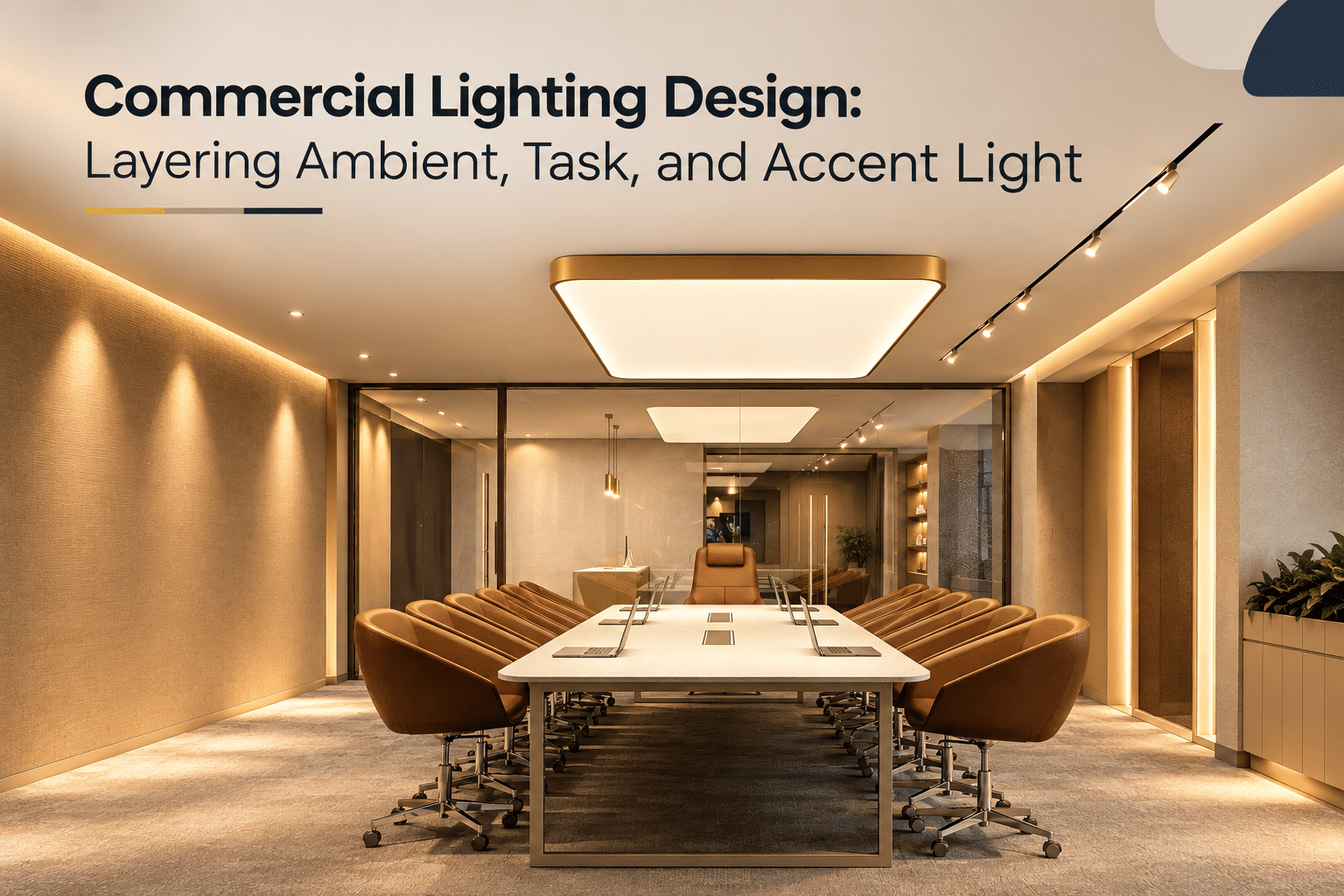
Commercial Lighting Design: Layering Ambient, Task, and Accent Light
| Commercial lighting design is the planning of light in business environments – offices, retail, restaurants, hotels, clinics, and exteriors, to balance function, brand experience, visual comfort, and energy efficiency. The core principle is layering three types of light: ambient (general), task (focused), and accent (dramatic). Used together, they give a space depth, hierarchy, and atmosphere that a single overhead layer never can. |
Light is the most powerful – and most underestimated material in any commercial interior. Get it right and a space feels effortless, premium, and unmistakably yours. Get it wrong and even the finest finishes fall flat. This is the discipline of commercial lighting design: the art and engineering of layering ambient, task, and accent light so a space performs beautifully for the brand and the people inside it.
Key Takeaways
- Three layers, one composition – Ambient sets the base, task adds function, accent adds emotion. Premium interiors use all three deliberately.
- The numbers matter – Color temperature (Kelvin), CRI, lux/foot-candles, and beam angle decide how a space actually feels and photographs.
- Controls are the finish – Dimming, tunable white, and scene control turn fixed lighting into a flexible, human-centric experience.
- Sector changes everything – A boutique, a boardroom, a fine-dining kitchen, and a hotel lobby each demand a distinct lighting strategy.
- Design intent must survive execution – Integrated lighting and interior design, with MEP coordination and turnkey delivery, is what protects the vision on site.
Planning a new fit-out or a refresh? Book a private lighting consultation with Creatabar – commercial lighting designers working across India, the GCC, and beyond.
What Is Commercial Lighting Design?
Commercial lighting design is the professional practice of specifying, positioning, and controlling artificial and natural light in commercial spaces to serve a business outcome. Unlike simply “installing lights,” it is a design decision that shapes how customers behave, how staff perform, how products sell, and how a brand is remembered.
A skilled commercial lighting designer works at the intersection of aesthetics and engineering – choosing luminaires, calculating illuminance levels, managing glare, coordinating with MEP and HVAC systems, and integrating daylight. Because light touches every surface, lighting and design can never be an afterthought; it is woven into the architecture from the first concept sketch. This is why the most respected commercial interior designers treat lighting as a primary layer of the interior, not a fixture bought at the end.
The Three Layers of Light: Ambient, Task, and Accent
Every considered scheme, from a flagship retail store in Dubai to a corporate HQ in Kochi, is built from the same three layers. Master how they interact, and you control the entire mood of a room.
1. Ambient Lighting (General Illumination)
Ambient light is the foundational layer – the even, comfortable glow that lets people move safely and perceive a space as a whole. It typically comes from recessed downlights, linear luminaires, cove lighting, or large pendant arrays. Good ambient lighting is uniform and glare-free; it should feel present but never harsh. In premium interiors, ambient light is often kept slightly restrained so the other layers can shine.
2. Task Lighting (Focused Function)
Task lighting delivers concentrated, higher-intensity light exactly where detailed activity happens – a reception desk, a workstation, a treatment chair, a chef’s line, or a retail cash counter. It reduces eye strain and lifts productivity. Think under – cabinet strips, adjustable desk luminaires, focused downlights, and commercial kitchen pendant lighting that keeps prep and plating crisp and safe. The rule: match the light level to the difficulty of the task.
3. Accent Lighting (Drama & Hierarchy)
Accent light is where design becomes emotion. It is directional light – track spots, adjustable downlights, wall grazing, wall washing, and uplighting, used to highlight what matters: a feature wall, artwork, a product display, a signature material, or an architectural detail. Accent lighting is typically about three times brighter than the ambient layer around it, which is what creates that luxurious sense of focus and depth. It is the single fastest way to make a commercial space feel curated rather than generic.
| Layer | Purpose | Typical Fixtures | Where It Shines |
| Ambient | Even, safe, overall illumination | Recessed downlights, linear LED, cove lighting | Every space – the base layer |
| Task | Focused light for activity & detail | Desk lights, under-cabinet strips, pendants | Desks, counters, kitchens, treatment areas |
| Accent | Highlight, drama & brand focus | Track spots, wall washers, uplights | Displays, art, feature walls, façades |
How to Layer Commercial Lighting: A Practical Framework
Here is the sequence our design studio follows when developing a lighting scheme for any commercial project:
- Map the space and its activities – Identify zones by how they’re used, circulation, focus work, transactions, dining, display, waiting.
- Set the ambient base – Establish comfortable, uniform general light at the right level for the sector.
- Add task light where work happens – Layer focused illumination onto desks, counters, kitchens, and service points.
- Introduce accent for hierarchy – Direct attention to hero products, materials, art, and architecture.
- Choose color temperature and CRI intentionally – Align the “feel” of the light with the brand.
- Design the controls – Layer dimming and scenes so the space adapts from morning to evening.
- Integrate daylight and control glare – Blend natural and artificial light for comfort and efficiency.
Commercial Lighting Design Fundamentals Every Brand Should Know
Commercial Lighting Design Fundamentals Every Brand Should Know
Color Temperature (Kelvin)
Measured in Kelvin (K), color temperature defines whether light feels warm and intimate or cool and clinical. It is one of the most emotionally powerful levers in lighting and design.
| Range | Appearance | Best For |
| 2700K – 3000K | Warm white – cosy, inviting, luxurious | Restaurants, hotels, lounges, premium retail, salons |
| 3500K – 4000K | Neutral white – balanced, focused, clean | Offices, clinics, showrooms, co-working spaces |
| 4000K – 5000K+ | Cool white – crisp, energising, high-detail | Supermarkets, workshops, labs, hospital exam areas |
Tunable white systems let a single space shift across this range through the day – warm and relaxed in the evening, brighter and more alert in the morning – a cornerstone of modern human-centric and circadian lighting.
Color Rendering Index (CRI)
CRI measures how accurately a light source reveals true colors, on a scale up to 100. For premium commercial interiors – where materials, food, skin tones, and merchandise must look their best – we specify high-CRI sources (typically 90+). Low-CRI light makes even beautiful finishes look dull and grey, which is why CRI is non-negotiable in luxury retail, fine dining, salons, and hospitality.
Brightness: Lumens, Lux & Foot-Candles
Lumens describe the total light a fixture emits; lux (and foot-candles) describe how much light lands on a surface. Professional schemes target recommended illuminance levels — general guidance places offices around 300–500 lux, retail sales floors higher, with feature displays brighter still, while restaurants and lounges are kept intentionally low and layered. The Illuminating Engineering Society (IES) publishes these recommended practices, and a good commercial lighting designer designs to them rather than guessing.
Beam Angle & Glare Control
Beam angle controls the spread of light – narrow beams for precise accenting, wide beams for even washes. Equally important is glare control: recessed or well-shielded fixtures, correct aiming, and matte surfaces prevent the harsh hotspots that make a space uncomfortable and unphotogenic. In premium environments, you should feel the effect of the light without ever seeing the source.
Lighting Controls, Dimming & Human-Centric Design
Controls are what turn a fixed installation into a living experience. Modern commercial LED lighting design integrates dimming, presence detection, daylight harvesting, and scene programming, often via protocols such as DALI, so one space can transform for different times, moods, and events. Human-centric (circadian) lighting goes further, tuning intensity and color temperature to support well-being, alertness, and comfort throughout the working day.
Commercial LED Lighting Design & Energy Efficiency
Premium and sustainable are no longer a trade-off. Commercial LED lighting design is the standard for every serious project because it delivers the aesthetics and the economics. According to the U.S. Department of Energy, LED lighting uses up to about 75% less energy and lasts up to 25 times longer than traditional incandescent lighting. Layer that with smart controls, daylight harvesting, and presence detection, and the running-cost and maintenance savings compound year after year.
For brands operating across India, the Gulf, and international markets, energy-efficient lighting also supports green-building goals and long-term operational value – the kind of quiet, intelligent luxury that discerning clients notice.
How to Choose Commercial Lighting Designers Near You
Searching for commercial lighting designers near me or the right commercial interior designer can feel overwhelming. The best lighting design companies share a clear set of traits. Use this as your checklist:
A proven, multi-sector portfolio – Ask to see layered schemes across offices, retail, hospitality, and healthcare – not just one space type.
Genuine technical fluency – Color temperature, CRI, lux targets, beam angles, and controls should be discussed with confidence, not glossed over.
Integrated MEP coordination – Lighting must be designed alongside power, HVAC, and ceilings – not bolted on afterwards.
Turnkey delivery – A single accountable team from concept to handover ensures the designer commercial lighting intent is executed exactly as drawn.
Brand-first thinking – Great lighting and design express who you are, not a template.
A quality and long-term value mindset. Premium fixtures, correct specification, and craftsmanship pay back over the life of the space.
Frequently Asked Questions
- What is commercial lighting design?
Commercial lighting design is the planning and engineering of light in business spaces – offices, retail, restaurants, hotels, clinics, and exteriors, to balance function, brand experience, comfort, and energy efficiency. Great schemes layer ambient, task, and accent light.
2. What are the three layers of commercial lighting?
Ambient lighting (even, general illumination), task lighting (focused light for specific activities), and accent lighting (directional light that highlights features). Layering all three creates depth, hierarchy, and atmosphere.
3. What is the difference between ambient, task, and accent lighting?
Ambient fills a room evenly, task concentrates brightness where detailed work happens, and accent is directional and decorative, drawing the eye to a focal point. Ambient is the base, task adds function, accent adds drama.
4. What color temperature is best for commercial spaces?
Warm white (2700K – 3000K) suits restaurants, hotels, and luxury retail; neutral white (3500K – 4000K) suits offices and clinics; cool white (4000K – 5000K+) suits supermarkets and high-detail tasks. Tunable white lets one space shift across the day.
5. Is LED best for commercial lighting?
Yes. Commercial LED lighting design is the standard because LEDs use up to about 75% less energy and last up to 25 times longer than incandescent, per the U.S. Department of Energy – with precise dimming, tunable white, and excellent color rendering.
6. How do I find good commercial lighting designers near me?
Choose commercial lighting designers or a commercial interior designer with a strong multi-sector portfolio, technical fluency, in-house MEP coordination, and turnkey delivery. Creatabar provides integrated lighting and interior design across India, the GCC, and worldwide.
Conclusion: Light Is Your Brand, Made Visible
Exceptional commercial spaces are never lit by accident. They’re composed – ambient light for comfort, task light for function, accent light for emotion, all tuned through color temperature, CRI, and intelligent controls. That is the craft of commercial lighting design, and it’s what separates a space people pass through from one they remember.
If you’re ready to design (or redesign) a commercial space where the lighting does justice to the brand, partner with Creatabar – the award-winning commercial interior designers and lighting specialists trusted on 1,800+ projects across India, the GCC, and beyond. Let’s create something extraordinary.