Minimalism vs. Maximalism: Which Interior Design Style is Right for Your Space?
If you’ve ever sat across from a designer and been asked ‘minimalist or maximalist?’ – and felt completely unsure – you’re not alone. It’s one of the first questions that comes up in every commercial interior design brief, and it rarely has a simple answer.
The debate between minimalism and maximalism isn’t just aesthetic. It touches budget, footfall psychology, brand perception, and how productively people work or how long customers stay. For businesses in India and the GCC – where commercial real estate costs are significant, and brand differentiation is increasingly competitive – getting this decision right matters.
This guide breaks down both design philosophies in commercial terms: what they cost, where each performs best, and how experienced commercial interior designers navigate the choice.
Designing or refitting a commercial space? Get a free consultation with Creatabar
What is Minimalist Interior Design?
The most recognisable brands in the world Apple, Aesop, Rolls-Royce, Bottega Veneta use reduction as their primary design signal. Not because they can’t afford more. Because restraint, done precisely, communicates more than abundance can.
Minimalist interior design is built around one principle: every element must earn its place. Rooted in the Bauhaus movement of the 1920s and refined through Japanese wabi-sabi philosophy, modern minimalism strips away visual noise to reveal structure, proportion, and function.
Defining characteristics of minimalist style interior design:
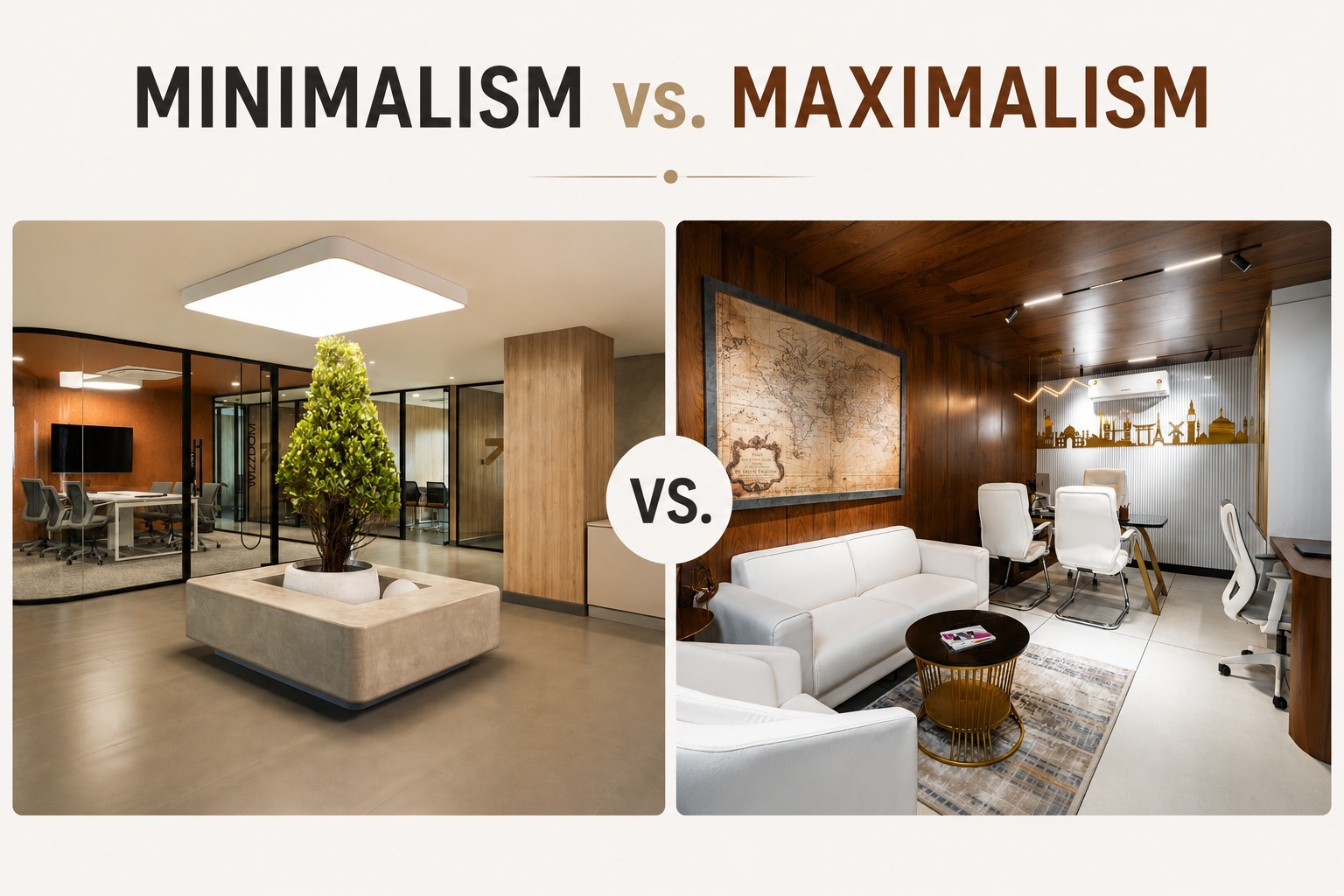
- Neutral colour palettes – whites, greys, warm beige, muted stone tones
- Clean geometric lines with deliberate negative space
- High-quality materials left in their natural state (concrete, glass, unfinished wood)
- Hidden storage solutions to maintain clutter – free surfaces
- Lighting as a design element rather than afterthought
- Furniture chosen for form – function balance, not decorative excess
In commercial contexts, minimalist interior design communicates precision, trustworthiness, and focus. It tells clients and employees: this organisation doesn’t waste resources on distraction.
Modern Minimalist Interior Design in 2025–2026
The cold, grey-white minimalism of the 2010s has moved on. What contemporary minimalist interior design looks like in India’s financial districts and the GCC’s business centres is warmer: Venetian plaster in sand and ochre, travertine replacing polished white marble, dark-stained timber set against brushed brass. The vocabulary is still restrained. The palette is just less clinical. In BKC, DIFC, Aerocity, and Sowwah Island, this is now the baseline expectation for a high-specification corporate or professional services interior. Getting it wrong – specifying minimalism at the wrong price point, where there’s nothing to look at and nothing worth looking at closely – reads exactly as badly as cluttered design would.
Building an office that reflects premium positioning? Talk to Creatabar’s minimalist interior designers
What is Maximalist Interior Design?
Maximalism rejects the idea that restraint equals sophistication. Where minimalism subtracts, maximalism adds – deliberately, confidently, and with intention. The common misconception is that maximalism means clutter. Done poorly, it can. Done well, it creates spaces that are impossible to forget.
Defining characteristics of maximalist interior design:
- Bold, saturated colour palettes – jewel tones, deep burgundies, emerald greens
- Layered textures: velvet, brass, terrazzo, patterned tile, exposed brick
- Curated collections of art, objects, and statement furniture
- Pattern mixing – geometric, botanical, and abstract in deliberate combination
- Statement lighting: oversized pendants, sculptural fixtures, dramatic chandeliers
- Rich material contrasts: metal against wood, marble against rattan
In commercial interiors, maximalism works when the experience IS the product. Restaurants, boutique hotels, retail flagships, salons – anywhere the customer’s sensory experience directly drives revenue – maximalism has a strong commercial case.
Minimalism vs. Maximalism: Side-by-Side Comparison
Here’s how the two design philosophies compare across key commercial interior design criteria:
| Dimesntion | Minimalist Interior Design | Maximalist Interior Design |
| Brand Signal | Authority, precision, trust | Experience, immersion,memorability |
| Material Approach | High specification – full exposure | High specification – layeredrichness |
| Spatial language | Negative space as a choice | Every surface activated |
| Client/guest response | Calm, confident, in control | Inspired, immersed, delighted |
| Revenue mechanism | Professional trust, client retention | Experience premium, rate uplift,dwell time |
| Maintenance | Lower – fewer surfaces | Higher – structured maintenancerequired |
| Longevity | Very high – timeless palettes | High with periodic refresh |
| Social content value | Subtle – brand prestige imagery | High – content-generatingenvironments |
| Best-fit sector | Corporate, finance, law,healthcare | Hospitality, F&B, flagship retail,spas |
| GCC application | DIFC offices, banking, clinics | Hotels, restaurants, malls,wellness |
| India application | BKC, Aerocity, Whitefield, BanjaraHills | Hotel groups, fine dining, lifestyleretail |
Which Commercial Sectors Suit Each Style?
When Minimalist Interior Design Works Best
Corporate offices and workspaces:
Focus and productivity are the primary outcomes of office interior design. Minimalist offices reduce cognitive load, lower visual distraction, and communicate professionalism to visitors and employees alike. Modern minimalist interior design in corporate environments typically features open floor plans, consistent material language across workstations, and integrated acoustic solutions.
Clinical environments benefit from minimalism for practical and psychological reasons. Clean lines reduce perceived visual stress in waiting patients. Easy-maintenance surfaces lower infection control risks. Neutral palettes support staff concentration and create calm.
Technology companies and co-working spaces:
Tech companies often choose minimalist style interior design to project innovation-through-simplicity. Apple’s retail and office philosophy is the most recognised example globally – stripped back architecture that makes the product the focus.
Financial services and legal firms:
Luxury minimalist interior design dominates premium professional services. A law firm or private bank uses restrained design to signal that nothing here is frivolous – which aligns directly with what their clients want to believe about them.
When Maximalist Interior Design Works Best
Restaurant interior design is a competitive field where differentiation is survival. Maximalist restaurants create environments where customers photograph and share their experience. In the GCC and Indian metro markets, Instagram driven foot traffic is a measurable business metric and maximalist restaurant design consistently outperforms neutral spaces for social engagement.
Retail maximalism creates environments customers want to spend time in. Longer dwell time correlates with higher average transaction value. Boutiques, apparel stores, and lifestyle retailers use curated maximalism to build immersive brand worlds.
From Kochi’s boutique heritage hotels to Dubai’s five-star resorts, maximalist hospitality design drives room rate premiums. When a guest books a hotel partly because of the interior aesthetic they’ve seen online, the design is doing commercial work.
Beauty salons and wellness centres:
The premium salon market has moved decisively toward maximalism rich materials, dramatic lighting, and an environment that feels like an event rather than a service transaction
Need a commercial interior designer who has delivered 1,200+ projects across India and the GCC?
The Psychology Behind Both Styles – What the Research Says
The minimalism vs. maximalism choice isn’t just about taste. There’s a body of environmental psychology research that explains why each works in specific commercial contexts.
Minimalism and Cognitive Load
Environmental psychologists have established that cluttered visual environments increase cognitive load – the mental effort required to process information. In workspaces, this translates to reduced focus and higher fatigue. A 2019 study published in the Journal of Environmental Psychology found that office workers in visually simplified environments reported 17% higher concentration scores compared to those in heavily decorated spaces.
Maximalism and Emotional Engagement
Hospitality researchers at Cornell’s Centre for Hospitality Research have documented that sensory-rich environments – characteristic of maximalist design – increase emotional engagement and willingness to pay premium prices. Guests in highly designed hotel lobbies consistently rated their overall stay experience higher, even when room quality was controlled.
What This Means for Commercial Interior Designers
Experienced commercial interior designers use these principles as decision frameworks, not rigid rules. The goal is always the same: design that serves the specific commercial objective of the space. A boardroom in a Dubai financial firm has a different goal than a rooftop restaurant in Kochi – and both deserve a design approach calibrated to that goal.
Can You Combine Minimalism and Maximalism?
Yes – and in commercial interior design, hybrid approaches are increasingly common. The spectrum between these styles has more positions than most clients initially realise.
Minimalist Structure, Maximalist Accents
This approach uses minimalist architecture – clean volumes, neutral base palette, disciplined spatial planning – and introduces maximalist moments through art installations, statement lighting, or a single feature wall. Many modern offices in Bangalore and Dubai tech campuses use this hybrid: calm, functional workspaces with a dramatic lobby or branded feature element.
Maximalist Palette, Minimalist Furniture
A restaurant might use bold tile patterns and rich paint colours while keeping furniture clean and unfussy. The visual complexity comes from surfaces and materials, not from objects. This maintains the atmosphere of maximalism while reducing maintenance complexity.
Zoned Design – Different Areas, Different Approaches
For larger commercial spaces hotels, mixed-use developments, corporate campuses – zoned design applies minimalism and maximalism to different areas based on their function. Reception areas might lean maximalist for brand impact. Meeting rooms and workstations lean minimalist for focus. Break areas and social zones use richer, warmer treatments.
How to Choose: A Decision Framework for Business Owners
If you’re still uncertain which direction suits your project, work through these questions with your commercial interior designers:
1. What is the primary function of the space?
Focus and productivity → lean minimalist.
Experience and brand immersion → lean maximalist.
2. Who is your customer, and what do they expect?
Premium professional service clients in finance or law generally expect minimalist restraint. Hospitality and retail customers increasingly expect environments worth experiencing. Know which expectation you’re meeting.
3. What is your brand identity?
Brands built on precision, efficiency, and trust tend toward minimalist expression. Brands built on creativity, warmth, and experience tend toward maximalism. Your space should be legible brand communication, not just decoration.
4. What are your operational constraints?
High-traffic commercial spaces in humid climates (Kerala coast, GCC summer) need practical material choices. Maximalist designs with many soft furnishings require more maintenance investment. Minimalist hard-surface designs are easier to clean and maintain.
5. What is your renovation cycle?
If you’re planning a 10-year space, minimalist architecture ages more gracefully than trend-driven maximalism. If you refresh every 3–5 years (common in hospitality), maximalist design with seasonal updates can be the more commercially effective choice.
2025 – 2026 Trends: Where Minimalism and Maximalism Are Heading
Modern Minimalist Interior Design Trends
- Biophilic minimalism: natural materials, living walls, indoor planting integrated into clean spatial layouts
- Warm minimalism: the move away from cold grey-white palettes toward warm sand, terracotta, and wood tones
- Acoustic minimalism: acoustic ceiling systems, fabric panels, and sound-absorbing materials that don’t compromise visual clarity
- Minimalist wellness design: circadian-aware lighting, ergonomic furniture, and air quality as design considerations
Maximalist Interior Design Trends
- Grandmillennial maximalism: traditional craftsmanship, hand-painted tiles, bespoke joinery, artisan objects in a modern commercial context
- Dopamine décor: high-energy, unapologetically cheerful colour palettes that drive mood and social media visibility in F&B and retail
- Neo-eclectic maximalism: mixing cultural influences, common in GCC hospitality as designers blend regional heritage with contemporary luxury
- Material maximalism: texture-forward design without heavy colour layering, stone, wood, fabric, and metal in neutral tones
Creatabar Interior Architecture – Commercial Design Across India and the GCC
Creatabar is a Kochi-based commercial interior architecture firm with projects across India and the GCC. The portfolio covers 1,200+ completed commercial projects, 10 lakh+ sq ft, and work in 12+ countries. The firm works in offices, hospitality, retail, healthcare, wellness, and mixed-use – across the full range of high-specification typologies. Corporate headquarters in Dubai’s DIFC. Fine-dining restaurants in Kochi, Bangalore, and Mumbai. Five-star hospitality interiors across the Gulf. Upscale healthcare clinics across India’s metro cities. Flagship retail environments in India’s and the GCC’s most significant addresses. The approach begins with the commercial brief, not the aesthetic brief. The question isn’t ‘which style do you prefer?’ It’s: what does this space need to achieve, and what design philosophy will deliver that outcome at the specification level the project demands? Whether the answer is minimalism, maximalism, or a hybrid deployed deliberately across a complex project, Creatabar’s in-house architectural design team, project management consultancy, and turnkey execution capability deliver it to the standard significant commercial clients across India and the GCC expect.
FAQs: Minimalism vs. Maximalism in Commercial Interior Design
Not necessarily. Entry-level minimalism is comparable in cost to entry-level maximalism. Luxury minimalist interior design is often more expensive than mid-range maximalist work because every material choice is visible and must be premium. The cost depends more on specification level than on the design philosophy.
Modern minimalist interior design is the dominant choice for corporate offices because it supports focus, communicates professionalism, and ages well. However, creative industries, agencies, and technology firms increasingly use hybrid approaches that bring personality into workspaces without sacrificing function.
Yes. In fact, maximalism can make small spaces feel more considered and intentional than minimalism, which requires generous square footage to avoid feeling sparse. A small café or boutique can use bold colour, interesting materials, and layered lighting to feel abundant rather than cramped.
Minimalist interior designers focus heavily on spatial planning, proportions, lighting design, and material selection. The work is less visible but more precise. They spend more time on what to remove than what to add, and they’re disciplined about preventing ‘feature creep’ during construction the tendency for clients to add elements that undermine the original concept.
At Creatabar, interior design projects exceeding 5,000 sq. ft. are handed over within 30 days, including concept design, detailed drawings, material specifications, and design documentation.
Generally, yes. More materials mean more maintenance requirements. Maximalist designs with soft furnishings, patterned fabrics, and multiple surface types require a structured maintenance schedule. In the GCC climate, dust management is a specific consideration. Creatabar specifies materials for local conditions as a standard part of every project brief.
Yes. Creatabar’s portfolio spans minimalist corporate offices in Kochi and Dubai, maximalist restaurants and hospitality venues across South India and the Gulf, and hybrid projects across multiple sectors. The firm’s position is that design philosophy should serve business goals not the other way around.
Minimalist interior design is the established choice for significant corporate headquarters in India’s business districts BKC, Nariman Point, Aerocity, Whitefield, Banjara Hills and across the GCC’s financial centres, particularly Dubai’s DIFC and Abu Dhabi’s Sowwah Island. The key is specification quality. Minimalism at a serious budget uses materials and finishes that communicate positioning at close inspection, not just at presentation distance.
High-specification minimalist interior design removes ornamentation while simultaneously increasing material quality to the point where each surface becomes the design statement. Custom millwork with invisible hardware. Book-matched stone in premium varieties. Architectural lighting systems. Acoustic engineering built invisibly into the architecture. The result looks effortless. Achieving it requires the kind of precision that only becomes apparent when something is done correctly.
At Creatabar, the design philosophy follows from the commercial brief, not the other way around. We establish the business type, target client profile, brand positioning, and commercial objective of the space before any aesthetic direction is discussed. The philosophy emerges from those parameters. This sequence commercial objective first, design language second produces interiors that work as business assets.
Start Your Commercial Interior Design Project