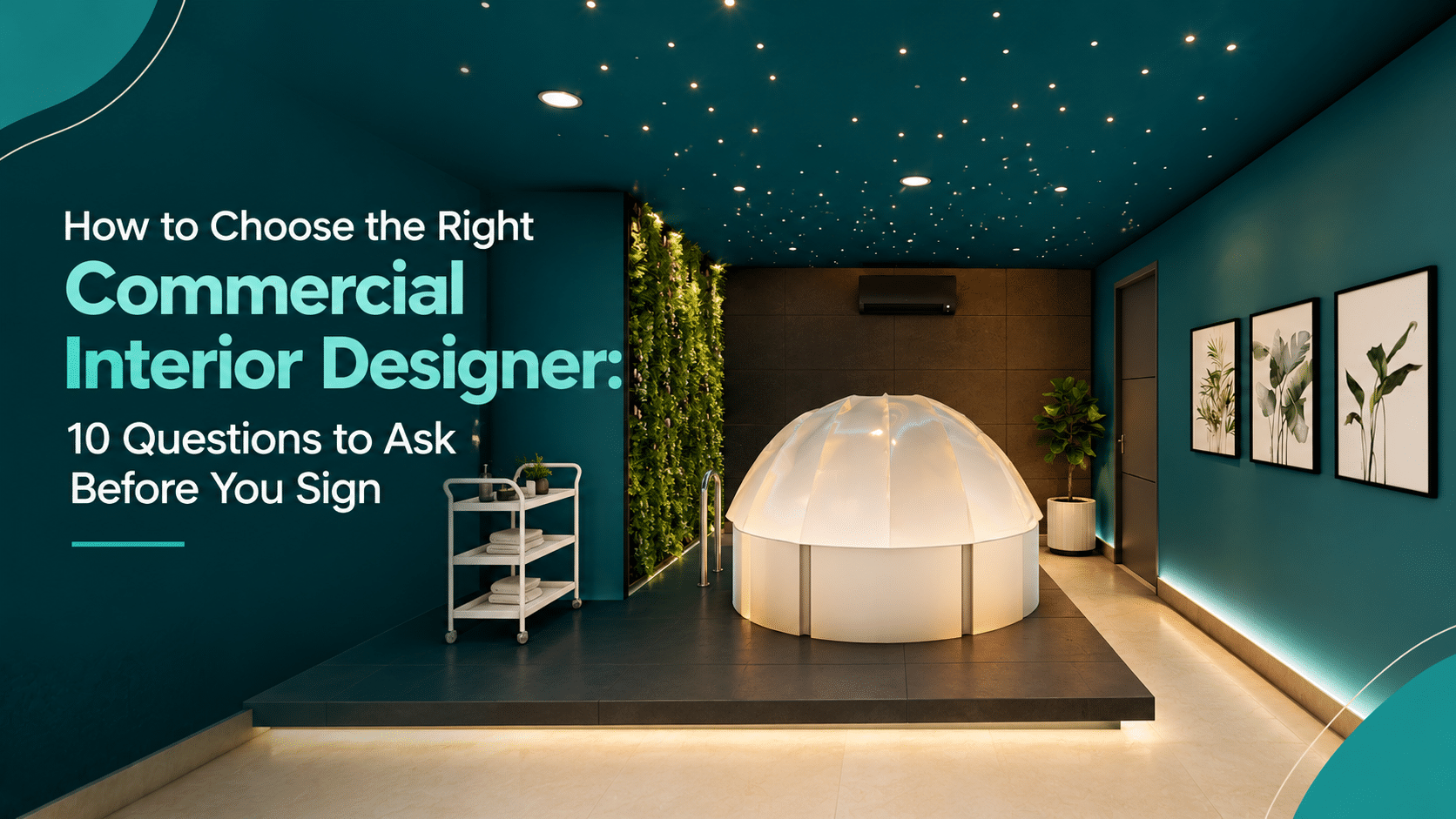
How to Choose the Right Commercial Interior Designer: 10 Questions to Ask Before You Sign
| The right commercial interior designer is a firm that owns your project end-to-end – concept, architectural drawings, project management, and on-site execution – under one contract and one point of accountability. Before you sign, verify their commercial (not residential) experience, their in-house execution capability, their MEP and compliance competence, and their track record of on-time, on-budget handovers in your sector. |
Choosing the right commercial interior designer is one of the highest-leverage decisions a business owner makes – the difference between a space that quietly drains capital and one that pulls in footfall, retains staff, and pays for itself. The right partner protects your budget, your brand, and your handover date. The wrong one leaves you managing five vendors, chasing a slipping timeline, and paying twice to fix it.
This guide gives you the ten questions that separate a genuine design-and-build partner from a decorator with a portfolio – plus what a strong answer actually sounds like, and the red flags to walk away from.
Why choosing the right commercial interior designer matters
A residential renovation is about taste. A commercial interior is about business outcomes – how many customers convert, how long guests stay, how productive your team is, and how strongly your brand is remembered the moment someone walks in.
That raises the stakes on who you hire. A commercial project touches structural work, MEP (mechanical, electrical, plumbing), HVAC, fire safety, accessibility, and local building compliance – none of which a purely decorative designer is equipped to manage. Get the partner right, and design becomes a return-generating asset. Get it wrong, and you inherit cost overruns, snag lists, and a space that works against your brand.
The ten questions below are how you tell the two apart before money changes hands.
The 10 questions to ask before you sign
1. “Do you specialise in commercial interior design – and in my sector?”
Why it matters: Commercial and residential interiors are different disciplines. A restaurant needs kitchen workflow, ventilation, and dwell-time psychology; an office needs acoustics, cable management, and space efficiency; a clinic needs infection-control-friendly finishes and patient flow. General “commercial interior designers” who dabble across everything rarely master the operational detail your sector demands.
A strong answer sounds like: “Here are three completed projects in your exact sector, the brief behind each, and the measurable result.” Ask to see work in your category – office, retail, restaurant, hotel, hospital, salon, or showroom.
Red flag: A portfolio that is 80% homes and apartments, with commercial work shown only as renders that were never built.
→ Browse Creatabar’s commercial portfolio across 10+ sectors.
2. “Do you handle the full turnkey fit-out, or only the design?”
Why it matters:
Not every project needs a turnkey package. What matters is knowing exactly what you are getting and who is responsible for each stage. If you choose design-only, the firm should provide a detailed set of drawings, specifications and documentation that another contractor can execute from. If you already have a contractor, the design team should also be able to coordinate with them or provide project management consultancy to help maintain design quality and execution standards.
A strong answer sounds like:
“We offer different engagement options depending on the project. For turnkey fit-out, we handle the design, technical detailing, procurement, and execution through one team. If you need design-only, we provide a complete set of technical drawings, specifications, and schedules that can be handed over to your contractor. If you already have a contractor, we can also support the project through PMC to coordinate design and execution.”
Red flag:
“We’ll give you a few design visuals, and you can find a contractor yourself.”
If there is no detailed documentation, technical support, or clarity on what happens after the design stage, you may face difficulties during execution.
3. “Who exactly will manage my project day-to-day?”
Why it matters: The person who charms you in the pitch is often not the person who runs your site. Commercial projects live or die on project management – coordination, procurement, quality control, and problem-solving under pressure. A dedicated PMC (Project Management Consultancy) layer is what keeps a fit-out on schedule.
A strong answer sounds like: You’re introduced to a named project lead, shown how progress is tracked against milestones, and told how often you’ll get updates.
Red flag: No single owner, or “we’ll figure that out after you sign.”
4. “Can you walk me through your process from brief to handover?”
Why it matters: A real firm has a repeatable, milestone-driven process. Vague answers signal improvisation – and improvisation is where budgets and timelines quietly die.
What a mature process looks like:
| Stage | What happens | What you receive |
| Concept | Discovery of brand, goals, and space | Mood boards, 3D visualisation, space plan |
| Design | Technical development | Material palette, finish schedule, MEP coordination, BOQ |
| Development | On-site turnkey execution | Civil, MEP, joinery, furniture, signage, snag-free handover |
A strong answer sounds like: A clear, staged explanation with defined deliverables and sign-off points at each step.
→ See how Creatabar’s concept-to-handover process works.
5. “How do you handle technical requirements, compliance, and approvals?”
Why it matters:
Commercial interiors involve much more than finishes and furniture. Electrical requirements, HVAC, fire and life safety, lighting, accessibility, signage, building regulations and other technical requirements can all affect the design and execution. These requirements can also vary depending on the building, location and project type. A good design partner should understand these requirements and coordinate the relevant consultants, authorities and building teams where required.
A strong answer sounds like:
“We review the project requirements at the design stage itself and coordinate the relevant technical services, consultants and building requirements. We make sure the design is developed with execution, safety and applicable regulations in mind, and support the approval and coordination process wherever it falls within our scope.”
Red flag:
“Once the design is finished, your contractor or landlord can take care of the technical requirements.”
If technical coordination is left until execution, it can lead to design changes, delays, additional costs and conflicts between drawings and site conditions.
6. “Can I speak to past clients and see completed sites?”
Why it matters: Renders are marketing. Built projects and referenceable clients are proof. The right commercial interior designers are proud to put you in touch with businesses they’ve delivered for.
A strong answer sounds like: A list of contactable references and an offer to visit or virtually tour a finished commercial space.
Red flag: Reluctance to share references, or a portfolio full of stock-perfect images with no client names, no locations, and no dates.
→ Read verified client testimonials.
7. “How will this design serve my business goals – not just look good?”
Why it matters: Beauty is table stakes. A commercial interior has a job: convert footfall in retail, increase dwell time and covers in hospitality, improve productivity and talent retention in offices, and reinforce brand recall everywhere. The right designer talks in outcomes, not just aesthetics.
A strong answer sounds like: “Tell me your commercial goals and constraints, and I’ll show you how the layout, lighting, and flow are engineered to deliver them.”
Red flag: The entire conversation is about “vibe” and finishes, with no mention of how the space performs.
8. “How do you protect my budget and timeline once we start?”
Why it matters: You asked us not to quote numbers here – and rightly so, because a serious commercial estimate can only follow a proper brief. But how a firm safeguards budget and schedule is fair game, and it’s revealing. Look for structured cost control: a detailed BOQ (Bill of Quantities), transparent procurement, and a schedule tracked from day one.
A strong answer sounds like: “We lock scope, quantify it in a BOQ, and track progress against milestones so there are no surprises – variations are documented and approved before they proceed.”
Red flag: A suspiciously low headline figure with no BOQ. Cheap up front almost always means expensive later.
9. “What does your handover include – and what happens after?”
Why it matters: The final 5% is where amateur projects fall apart. A professional handover means a walkthrough, a resolved snagging list, as-built documentation, and a defined post-completion support window. This is the difference between “it’s done” and “it’s actually finished.”
A strong answer sounds like: A clear handover protocol, snag resolution, warranties on workmanship, and a point of contact after you move in.
Red flag: No snag process, no aftercare, and radio silence once the final invoice clears.
10. “Can you deliver across multiple locations and standards?”
Why it matters: If you’re a growing brand, you may need consistent design and execution across cities or across countries. Rolling out the same standard in Kochi, Bangalore, Dubai, and Riyadh requires a firm with genuine multi-location delivery experience, not a local operator stretched beyond its reach.
A strong answer sounds like: Demonstrated delivery across India, the GCC, and globally, with systems to maintain brand and quality consistency at every site.
Red flag: A single-city firm promising international delivery it has never actually done.
→ Planning a multi-city or GCC rollout? Start the conversation.
The right vs. the wrong commercial interior designer – at a glance
| Signal | The right partner | Walk away |
| Scope | Turnkey design-and-build, one contract | Design only, then hands you off |
| Accountability | Single point of ownership | Multiple vendors, shared blame |
| Sector fit | Built projects in your category | Mostly residential or unbuilt renders |
| Technical | In-house architectural + MEP + PMC | “Someone else handles that” |
| Proof | Contactable clients, site visits | No references, no dates |
| Focus | Business outcomes + design | Only aesthetics |
| After handover | Snag resolution + aftercare | Disappears after final invoice |
“Commercial interior designers near me” – does location still matter?
Searching for commercial interior designers near me makes sense for site visits and local compliance knowledge, but for a premium project, capability matters more than postcode. The best outcome comes from a firm that combines local approval expertise with the systems to deliver at scale.
Creatabar is headquartered in Kochi, Kerala, and delivers commercial interiors across India – Bangalore, Chennai, Mumbai, Hyderabad, Delhi NCR, and internationally across the GCC, including Dubai, Abu Dhabi, Riyadh, Jeddah, Doha, Kuwait City, and Muscat, with a presence spanning 12+ nations.
How Creatabar answers all ten questions
We built Creatabar around exactly these questions. As an award-winning commercial interior design firm recognised as Most Futuristic & Trendsetter Interior Design & Architectural Design Firm of the Year 2024, we deliver premium, brand-aligned commercial interiors end-to-end:
- One team, total accountability – concept, architectural design, PMC, and turnkey fit-out under one roof.
- Sector depth – corporate offices, healthcare sectors, educational institutions, hotel apartments and resorts, fine dining restaurants, and other commercial spaces.
- Proven scale – 1800+ completed projects, 45 lakh+ sq ft designed, across 12+ nations.
- Outcome-driven design – spaces engineered to lift footfall, dwell time, productivity, and brand recall.
We don’t compete on being the cheapest. We build spaces that elevate premium and luxury brands, and stand up to the ten questions above without flinching.
→ Book your free, no-obligation consultation with Creatabar.
Frequently asked questions
What is a commercial interior designer?
A commercial interior designer plans and delivers interiors for business spaces offices, retail stores, restaurants, hotels, clinics, and showrooms balancing brand, function, compliance, and commercial performance. Unlike residential designers, they manage MEP, building regulations, and business outcomes such as footfall and productivity.
How do I choose the right commercial interior designer?
Verify commercial (not residential) experience in your specific sector, confirm they offer full turnkey design-and-build under one contract, check their in-house architectural, MEP and project-management capability, and ask for contactable references and completed sites. The right partner talks in business outcomes and offers a clear concept-to-handover process.
What’s the difference between an interior designer and a turnkey fit-out firm?
An interior designer typically delivers concepts and drawings. A turnkey fit-out firm handles design and execution – civil, MEP, joinery, furniture, and finishing under a single contract, giving you one point of accountability from brief to handover.
Do commercial interior designers handle approvals and compliance?
The right ones do. Reputable firms coordinate fire safety, HVAC, accessibility, and local authority approvals – essential for occupancy sign-off in both India and the GCC. Always confirm this capability before signing.
Should I hire a local commercial interior designer or a firm that works across regions? Local knowledge helps with approvals and site visits, but delivery capability matters more. A firm that combines local compliance expertise with multi-location systems like Creatabar across India, the GCC, and globally gives you both.
What questions should I ask before signing a contract?
Ask about sector-specific experience, turnkey scope, your dedicated project lead, the full process, MEP and compliance handling, references, business-outcome focus, budget and timeline safeguards, handover and aftercare, and multi-location capability the ten questions detailed in this guide.
Conclusion: ask before you sign
The right commercial interior designer isn’t the one with the prettiest deck it’s the one who owns your outcome end-to-end, proves it with built work, and answers all ten of these questions without hesitation. Ask them before you sign, and you protect your budget, your brand, and your handover date.
At Creatabar, these questions aren’t a test we hope to pass, they’re how we already work. If you’re planning a premium commercial space anywhere across India, the GCC, or globally, let’s talk about what it should do for your business.
→ Start your project with Creatabar — book a free consultation today. One team. One contract. Total accountability from brief to handover.